Agricultural sector in Nigeria faces unprecedented challenges in feeding over 200 million people in the country while maintaining a sustainable environment. The sector is constrained by climate change impacts, widespread soil degradation and inefficient resources allocation despite contributing significantly to the nation's Gross Domestic Product (GDP) and employing 70% of the rural workforce. The primitive farming method does not provide the precision required for optimal yield generation while minimizing environmental degradation. The fundamental gap in knowledge is the absence of integrated digital frameworks that combine satellite remote sensing, artificial intelligence and local agricultural knowledge systems specifically adapted to Nigeria's agroecological conditions.
Despite the industrial revolution and digitalization in global agriculture, most solutions are developed for temperate regions with different climatic patterns, soil types and farm mechanisms. Nigeria’s diverse agroecological zones, spanning from the Sudan savanna to coastal forests, require localized methods that integrate traditional knowledge with cutting-edge technology. This study is aimed at developing a comprehensive digital framework that harnesses satellite data and machine learning algorithms to optimize crop yields while quantifying and minimizing environmental impacts in selected agricultural zones in the southwestern part of the country.
This research employs a robust mixed-methods approach by integrating remote sensing, machine learning and extensive field validation across Oyo, Ogun, Ondo and Lagos states. Weather data from the Nigerian Meteorological Agency and global climate databases are integrated with soil composition data from national surveys and targeted field sampling. Primary data were gathered through structured surveys and participatory mapping exercises across 400 locations, complemented by real-time market price data from the Bureau of Statistics of the targeted states. Multiple Linear Regression was the baseline for this study, while Machine Learning (ML) algorithms, including Random Forest (RF), Gradient Boosting Machines (GBM) and Support Vector Machines (SVM), are deployed for yield prediction modelling. Geospatial analysis utilizing Google Earth Engine enables large-scale environmental monitoring, while time series analysis of Normalized Difference Vegetation Index (NDVI) and Enhanced Vegetation Index (EVI) provides vegetation health insights. Field validation involves satellite observations with actual crop yield measurements across multiple growing seasons. Model performance is evaluated using cross-validation techniques, with accuracy metrics including Root Mean Squared Error (RMSE), Mean Absolute Error (MAE) and R-squared values.
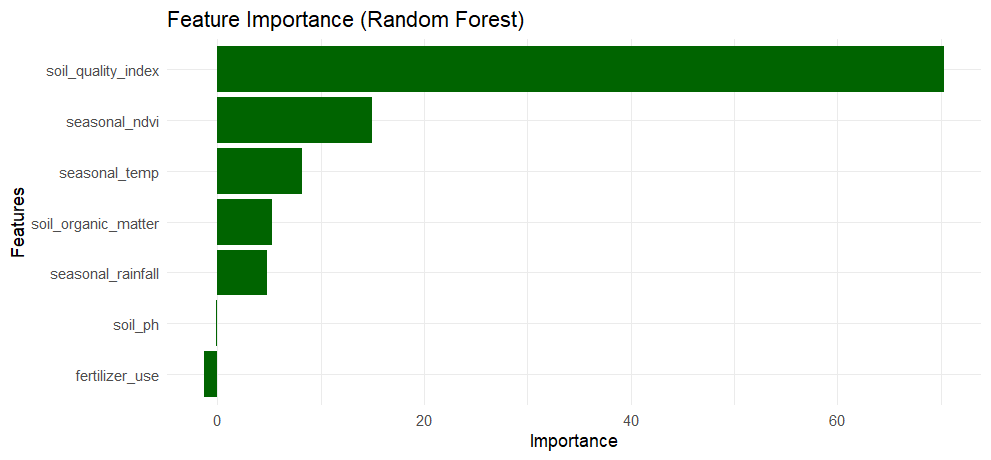
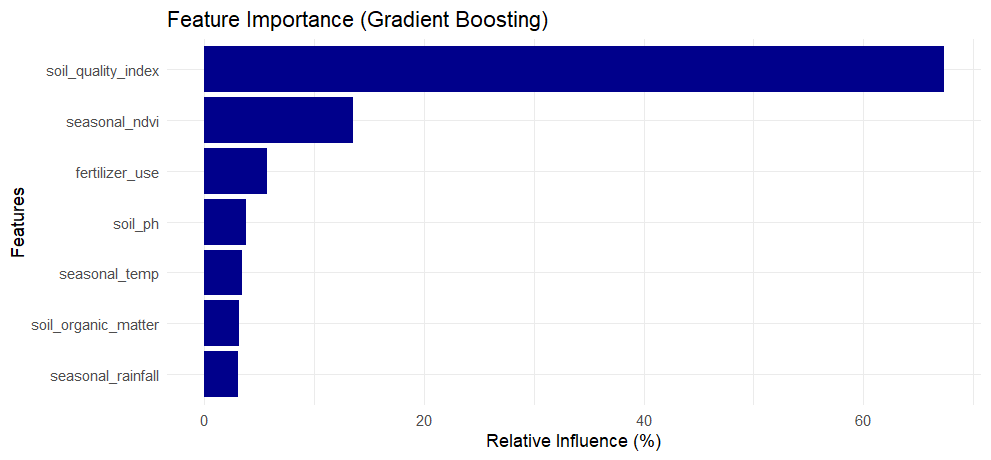
The developed framework demonstrates exceptional performance across all tested machine learning algorithms. SVM achieved the highest predictive accuracy with R-squared values of 84.72%, RMSE of 0.1757 tonnes/hectare and MAE of 0.1232 tonnes/hectare. Feature importance analysis for both RF and GBM revealed that soil quality index, seasonal NDVI values, soil organic matter and seasonal rainfall are the most critical yield predictors. Ondo State showed the highest average yields at 0.728 tonnes/hectare, as well as the highest average rainfall and average NDVI at 1391mm and 0.575 tonnes/hectare, respectively. The system identified optimal planting windows, reducing yield variability by 34% compared to primitive timing methods. Optimized fertilizer application reduced nitrogen usage by 28% while maintaining yield levels. Water use efficiency improved 22% through precision irrigation scheduling. Carbon footprint analysis indicated potential greenhouse gas emission reductions of 15-20% through optimized farming practices.
This study establishes an innovative integration of multiple data sources, demonstrating how artificial intelligence can be effectively deployed to address critical gaps in the existing agricultural support system in Nigeria. The framework emphasises environmental sustainability while optimising yields, offering a practical pathway towards achieving United Nations (UN) Sustainable Development Goals (SDG) 2 (Zero Hunger), 6 (Clean Water and Sanitation), 13 (Climate Action) and 15 (Life on Land). Subsidy programs should incentivize precision agriculture adoption among smallholder farmers. Agricultural stakeholders should prioritize digital agriculture infrastructure that represents a transformative approach to sustainable food production in Nigeria.