Estimating value added from the world’s agrifood systems
Conference
10th International Conference on Agricultural Statistics
Format: CPS Paper - ICAS 2026
Keywords: agrifood
Abstract
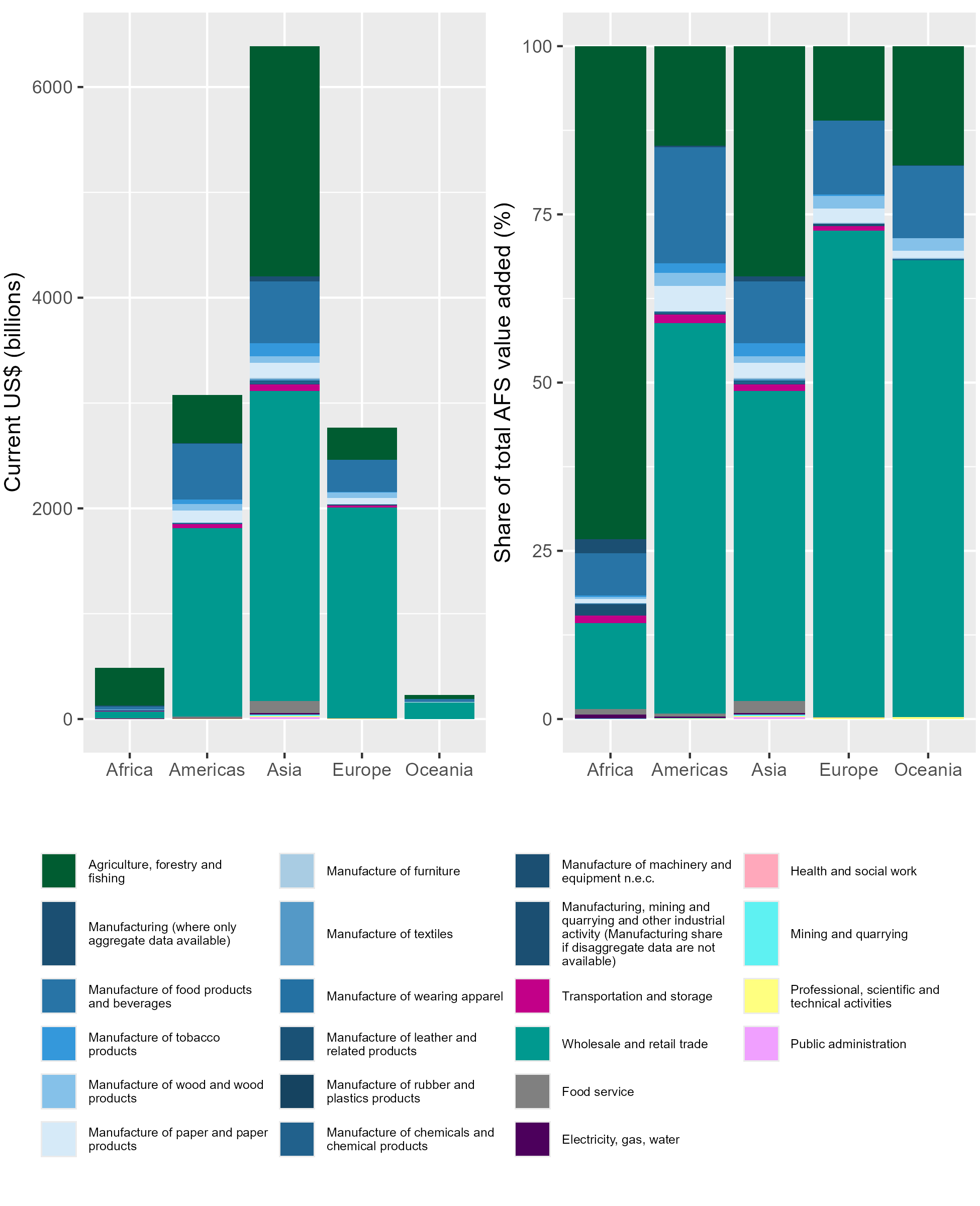
Agrifood systems transformation is required to reach national and global food security, development, and sustainability goals but depends on substantial public and private investment. Yet most official statistics are delimited by economic sectors, so existing data do not readily quantify the contribution of multisectoral agrifood systems to national economies or the world. Such incomplete accounting is most likely to undervalue agrifood systems’ economic contributions and hamper decision makers’ ability to justify action. We fill this gap using official statistics and harmonized input-output table data to estimate the value added accruing from agrifood systems output from 1995-2019. Our results show that the agrifood systems of 170 countries contributed nearly $13 trillion (current US$) to global GDP in 2019, 15.4% of global GDP. Of that, primary production (agriculture, forestry, fishing) contributed only 26.1% ($3.3 trillion) while wholesale and retail trade comprised the largest share (53.4%; $6.8 trillion), followed far behind by manufacturing of agrifood products (food, beverages, wood, paper, etc.). Further, we show that agrifood systems are increasingly diversified at higher national incomes. The share of value added from agrifood systems per capita excluding primary production follows the same well-known decline with GDP per capita as agriculture. Our study helps to close an important data gap in understanding the economics of agrifood systems inclusive of the middle of value chains that enables future research on the economic contribution of food systems as they undergo the necessary transformations to meet ambitious economic, social, and environmental goals.
Figures/Tables
Figure 1