Optimizing the Formulation of Questions on Food Losses in National Agricultural Surveys
Conference
10th International Conference on Agricultural Statistics
Format: CPS Paper - ICAS 2026
Keywords: agricultural statistics, agricultural surveys, food, food security, losses
Abstract
Food losses represent a critical challenge that negatively affects food security, household nutrition, the economy, environmental sustainability and the agri-food system in general. According to the FAO, 13.3% of global food production, equivalent to 1.3 billion tons or 120 kilograms per capita, was lost in 2023 between harvest and retail (FAO, 2025). Accurate information on these losses is essential to guide effective public policies and reduction strategies. In response, countries in Latin America, such as Mexico (ENA 2019), Costa Rica (ENA 2023), and Peru (ENA 2025), have incorporated specific questions on farm-level food losses in their National Agricultural Surveys, while several African countries have, with support from the Global Strategy for Agricultural and Rural Statistics (GSARS), included similar modules in their surveys. However, survey responses tend to underestimate the extent of losses, leading to unreliable data for decision-making. This article focuses on identifying efficient and cost-effective strategies to formulate questions that allow more accurately to capture food losses on the farm, seeking to improve the quality and usefulness of the data collected in annual agricultural surveys. The analysis will include an assessment of the strengths and weaknesses of the different survey formats and strategies, as well as practical recommendations for their implementation in the annual agricultural surveys of Latin America and Africa, considering the cultural, economic and operational differences in these regions. The results of this study will guide national statistical offices, ministries of agriculture and other relevant ministries in designing food loss modules that capture relevant information in a format and standard that can generate good quality data that can inform food loss reduction policies and strategies.
Figures/Tables
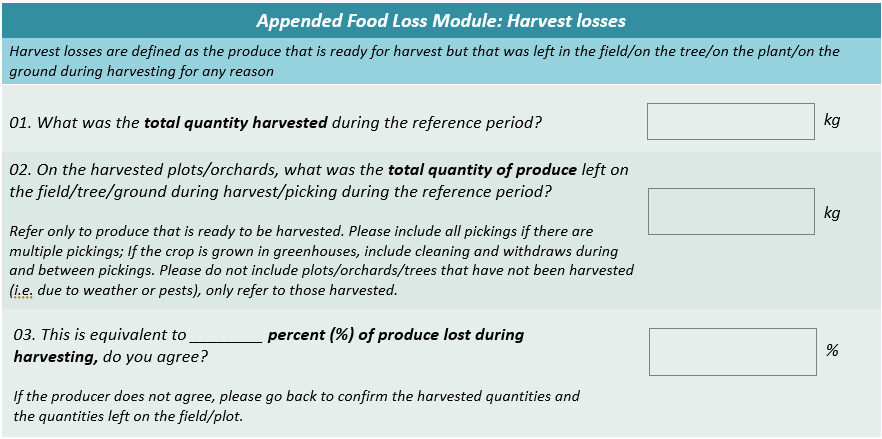
Questions on harvest losses