Institutional Challenges to Poverty Alleviation: Assessing the Synergistic Impact of Land Rights, Extension, and Financial Services in Tanzania
Conference
10th International Conference on Agricultural Statistics
Format: CPS Abstract - ICAS 2026
Keywords: credit market, extension, land, poverty
Abstract
Background and Objectives
Tanzania, despite implementing structural reforms, continues to struggle with high poverty rates, particularly in rural areas where agriculture remains the primary source of livelihood. Recognizing agriculture's potent poverty-reducing potential, the government has initiated land tenure reforms, such as the Land Tenure Improvement Project (LTIP), to strengthen property rights. However, these reforms occur within a context of severely constrained complementary institutions: formal rural credit is limited, and agricultural extension services are critically understaffed. This study investigates a central question: Can secure land rights alone deliver meaningful poverty reduction, and what is the additional benefit of simultaneously improving credit market performance and agricultural technical knowledge? Specifically, we rigorously examine the individual and joint impacts of secure land rights, access to credit, and receipt of extension services on household welfare in Tanzania. It moves beyond evaluating these institutions in isolation to model their critical complementarities, providing an ex-ante assessment of the ongoing land reforms under real-world constraints.
Data and Methodology
The analysis utilizes high-quality panel data from the Tanzania Living Standards Measurement Study – Integrated Surveys on Agriculture (LSMS-ISA) for 2014/15 and 2020/21. We constructed multiple welfare outcomes: expenditure-based poverty measures using both international ($2.15/day) and national ($1.35/day) poverty lines, a Multidimensional Poverty Index (MPI), and a normalized asset index to capture long-term wealth accumulation. The core methodological challenge is the non-random self-selection of households into different institutional regimes. To address this endogeneity, the study employs a Multinomial Endogenous Switching Regression (MESR) model, augmented with an instrumental variables (IV) strategy. This approach allows for the estimation of causal effects by modeling household choice among seven mutually exclusive categories of institutional access (e.g., land rights only, land rights + credit, all three services) while controlling for both observed and unobserved heterogeneity.
Key Findings
The results demonstrate that the effectiveness of land tenure security is highly dependent on complementary institutions.
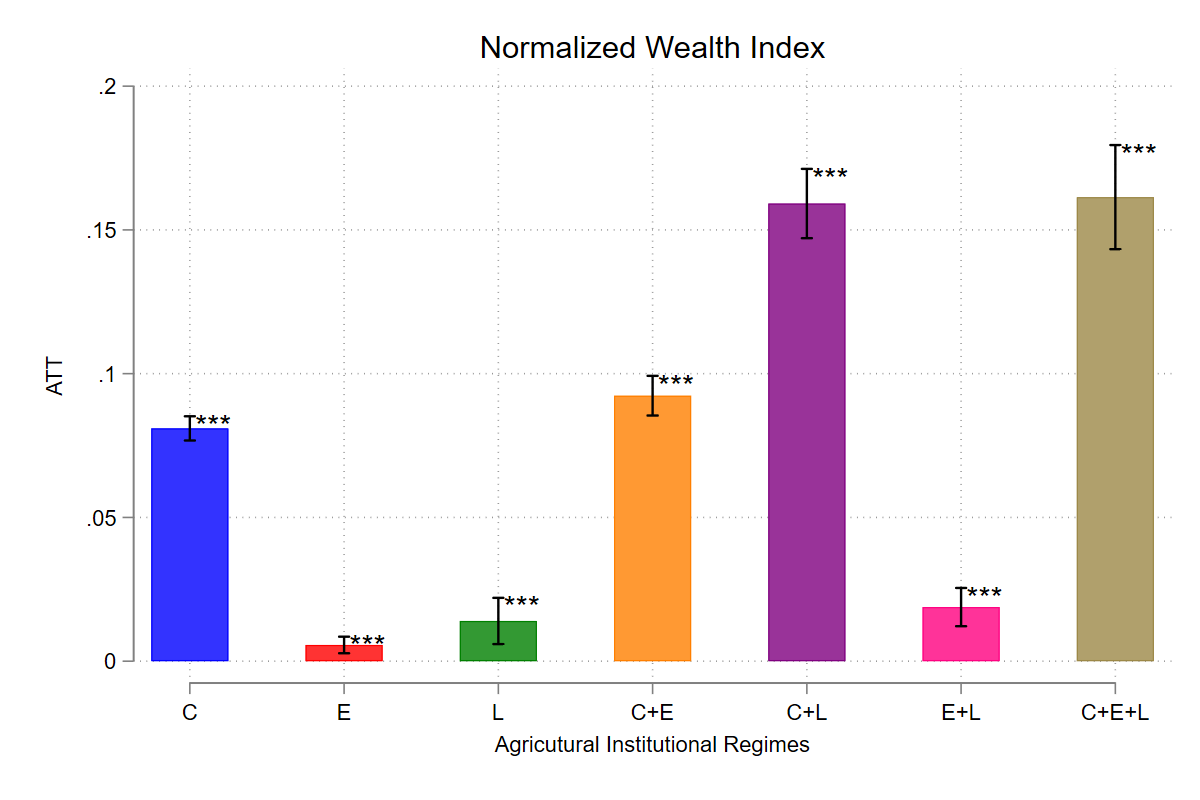
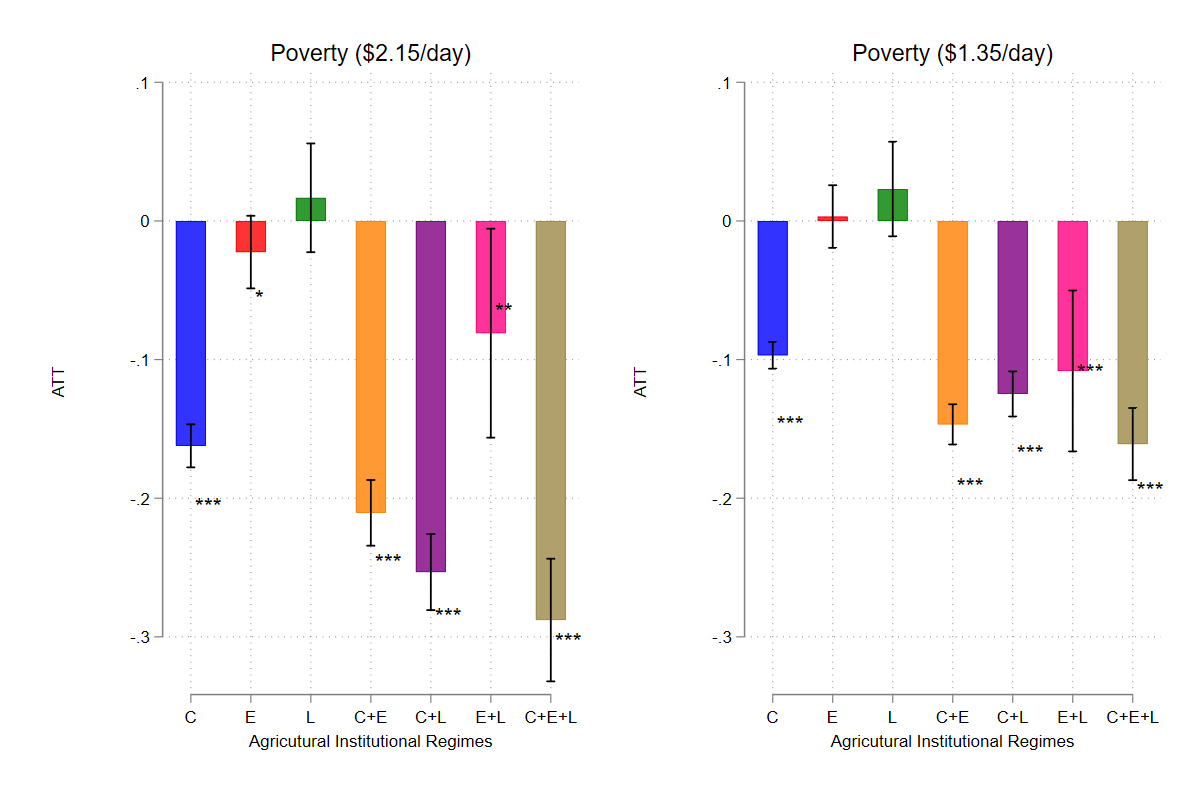
1. Limited Impact in Isolation: Possessing formal land rights alone yields only modest improvements in asset accumulation and no statistically significant reduction in consumption poverty. Similarly, extension services alone have minimal impact.
2. Power of Complementarities: The effects are significantly amplified when land rights are combined with other services. The strongest two-service effect is achieved by combining land rights with credit, reducing the likelihood of poverty by 13-25 percentage points. The combination of land rights and extension reduces poverty by 7-11 points.
3. The Full Institutional Bundle: The most pronounced welfare gains occur when households access all three services simultaneously. This package reduces poverty by 16 percentage points at the national line and 25 points at the international line, while also significantly reducing multidimensional poverty and boosting asset wealth.
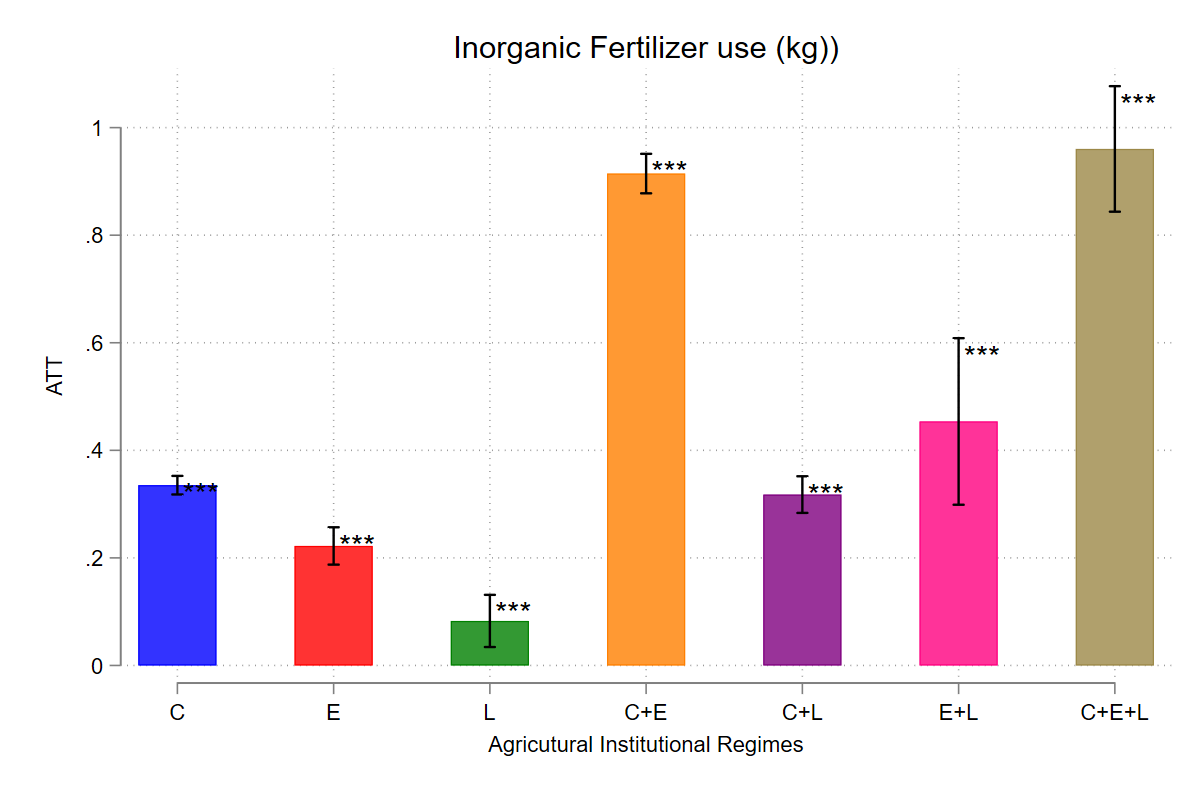
4. Pathway Mechanisms: Analysis of pathways confirms that these combinations work by enabling increased investment. The bundle of land rights, credit, and extension leads to a near-doubling of inorganic fertilizer use and a significant increase in the adoption of modern farming practices and land investments (e.g., soil conservation, fallowing).
Conclusion and Policy Implications
The findings robustly confirm that secure land tenure, while necessary, is insufficient for substantial poverty reduction in Tanzania. Its benefits are unlocked only when complemented by financial liquidity and technical knowledge. The study concludes that the success of Tanzania's ambitious land tenure reforms under the LTIP is critically hinged on parallel investments to improve rural financial inclusion and revitalize agricultural extension systems.
Policymakers should therefore prioritize integrated, bundled interventions over standalone land formalization. Strategies must consciously layer access to credit and extension onto tenure security programs to create synergies that catalyze agricultural investment, productivity, and, ultimately, meaningful poverty reduction. The study provides a rigorous empirical basis for advocating a holistic approach to rural institutional reform, aligning with the need to address multiple constraints to agricultural productivity in Africa simultaneously.
Figures/Tables
poor215_national_all_tech
inorganic_base0
wealth_norm_base0