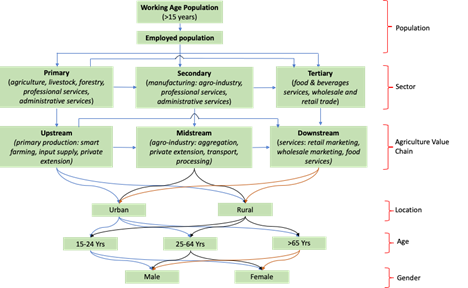
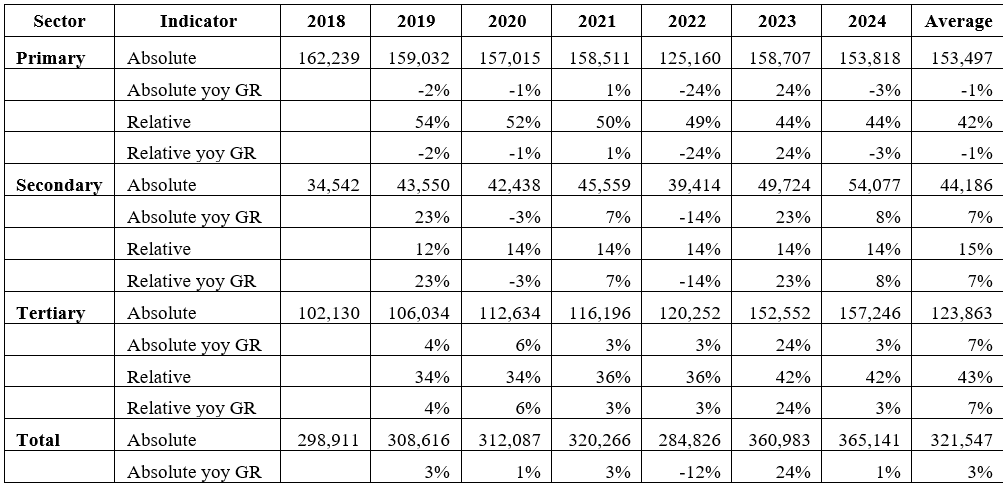
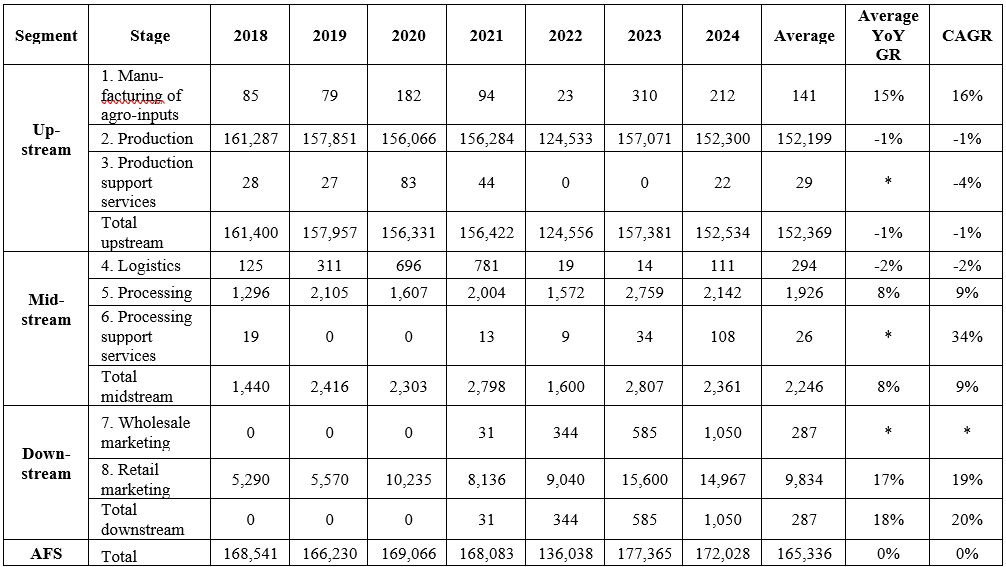
Bhutan, a landlocked country with a unique development approach, faces an existential threat in its labor market as young people emigrate to find jobs elsewhere. As many Bhutanese remain active in activities linked to the agrifood system (AFS), transforming the AFS can contribute to more and better jobs as part of the wider structural transformation process. In this paper, we apply a new approach for assessing employment patterns across the different segments of the AFS. Typically, labor force statistics disaggregate employment by traditional economic sectors and equate agricultural employment with being active in primary production. However, this approach does not adequately capture the employment shifts related to AFS transformation, as jobs relocate off the farm towards industry or service activities that add value to primary production. By identifying and categorizing industry and occupation to different AFS jobs in a panel of Bhutan’s labor force surveys from 2018 to 2024, this paper applies an AFS lens to national employment statistics. We find that the AFS employs most Bhutanese, but the traditional approach (48%) of assessing agricultural employment underestimates the actual employment in AFS (52%). The growth in jobs outside the AFS (7%) is larger than in the (stagnant) AFS (0%), suggesting that new entries enter into non-AFS jobs and hence the share of AFS employment in total employment declines. Moreover, as the number of AFS jobs in absolute terms remains stable over time, the suggesting that little movement is happening from AFS to non-AFS jobs. Within the AFS, labor remains highly concentrated in upstream production activities and the release of labor off the farm happens slow (an annual growth rate of -1%). We do observe more employment in the crop sector over time while mixed farming is declining over time, which could indicate that more specialization is happening within production. As new employment in the AFS is related to retail activities, the share of jobs in the upstream AFS segment is growing (fast) over time, but starting from a low base. At the same time, just 1% of agrifood jobs are in the AFS midstream segment, and employment in the processing industry is low by any standard. We find that jobs in the downstream AFS segment earn hourly incomes that are on average 90% more than jobs in the upstream segment but are not statistically different from the hourly income earned outside the AFS. This suggests that there is an income benefit from a reallocation of labor from up to downstream within the AFS without laborers leaving the AFS altogether. Our findings have important implications for designing policies and interventions to strengthen the potential of the AFS to contribute to the creation of more and better jobs. First, the introduction of new technologies that improve labor productivity can initiate the release of labor from the currently dominant production stage of upstream AFS segment. Second, polices addressing the underlying barriers to agro-industry development can create more jobs in the AFS midstream segment. Finally, Bhutan should create an enabling environment and build skills for Bhutanese youth to innovate and compete in niche markets.