Modernised Annual Frame Survey Data Collection System in the Small-Scale Fisheries in Malawi
Conference
10th International Conference on Agricultural Statistics
Format: CPS Paper - ICAS 2026
Keywords: census, fisher, illegal fishing, livelihood, sustainability
Abstract
Malawi is endowed with a diverse natural resource base that includes fisheries resources in the major waterbodies, that include Lakes Malawi. The Department of Fisheries champions the management and conservation of the fisheries resources. One of the critical areas of fisheries management involves the management of fishing effort in the country. In pursuit of this endeavour, the Department of Fisheries conducts Annual Frame Surveys in all the major water bodies. These surveys are defined as an annual census of the basic fishing effort indicators, providing a basis for the fishing effort management. The fishing effort indicators are categorised as fishers (comprising gear owners and fishing crew members), numbers and types of fishing crafts, and numbers and types of fishing gears.
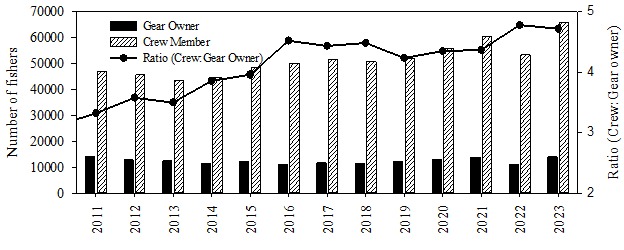
The 2024 Annual Frame Survey indicates some significant changes to the fishing effort indicators. A total of 79,668 fishers were recorded in the current survey, indicating an increase of 17% from 66,435 fishers recorded in 2023. Out of this, 13,928 were gear owners and 65,740 crew members, representing 25% and 19%, respectively increase from last year’s survey. Most of the fishers were found in Mangochi district (17,474), followed by Nkhotakota district (10,379), with the least number of fishers registered in Dedza district (1,010). This situation demonstrates an increase in the levels of direct employment and community participation in the country’s fishing sector.
The current survey recorded a total of 21,530 fishing crafts, representing an increase of 12% from the 19,299 recorded last year. The recorded fishing crafts mainly comprised dugout canoes (55%), planked canoes (19%), boats without engines (11%) and boats with outboard engines (15%). Most of these fishing crafts are in Mangochi (4,899), followed by Karonga (3,310), Nkhatabay (3,236), Nkhotakota (2,656) and Salima 2,056), thereby contributing 23%, 15%, 15%, 12% and 10% to the total number of crafts. The increase in the number of fishing crafts demonstrates increased investment in terms of ownership and utilisation of fishing equipment and accessories in the country.
At the district level, the number of fishers, fishing crafts and fishing gears has increased over the numbers recorded in the 2023 annual frame survey, except for Mangochi district. For instance, the number of fishers in Nkhotakota, Karonga, and Nkhatabay has increased by 57%, 28% and 27%, respectively. In Mangochi district, the number of fishers and fishing crafts has declined by 7.2% and 6.6%, respectively. Mangochi further reported a drop in the legal gillnets as well as beach seines from the previous survey results. These declines are a result of most fishers migrating from Lake Malombe in Mangochi to Lake Chiuta in Machinga and Lake Chilwa in Zomba.
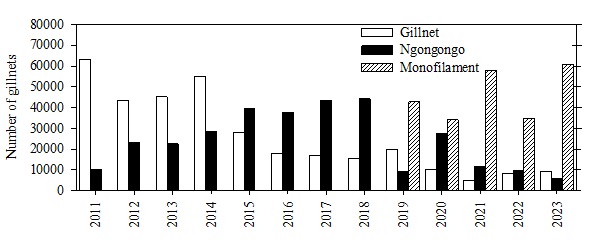
The proliferation of illegal fishing gears and fishing methods cannot be overemphasised in most of the fishing districts. For instance, the utilisation of mosquito nets and monofilament gillnets has become common in virtually all the fishing districts in the country, with increasing trends. The utilisation of illegal fishing gears needs to be stopped by the districts so that fishing effort is maintained within acceptable and sustainable levels.
Figures/Tables
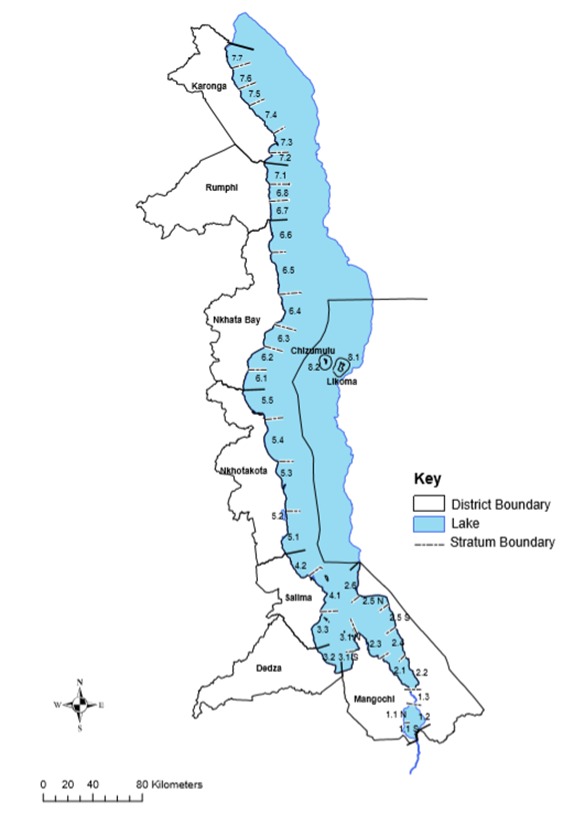
Map of the Study Area
Number of fishers
Number of Gillnets