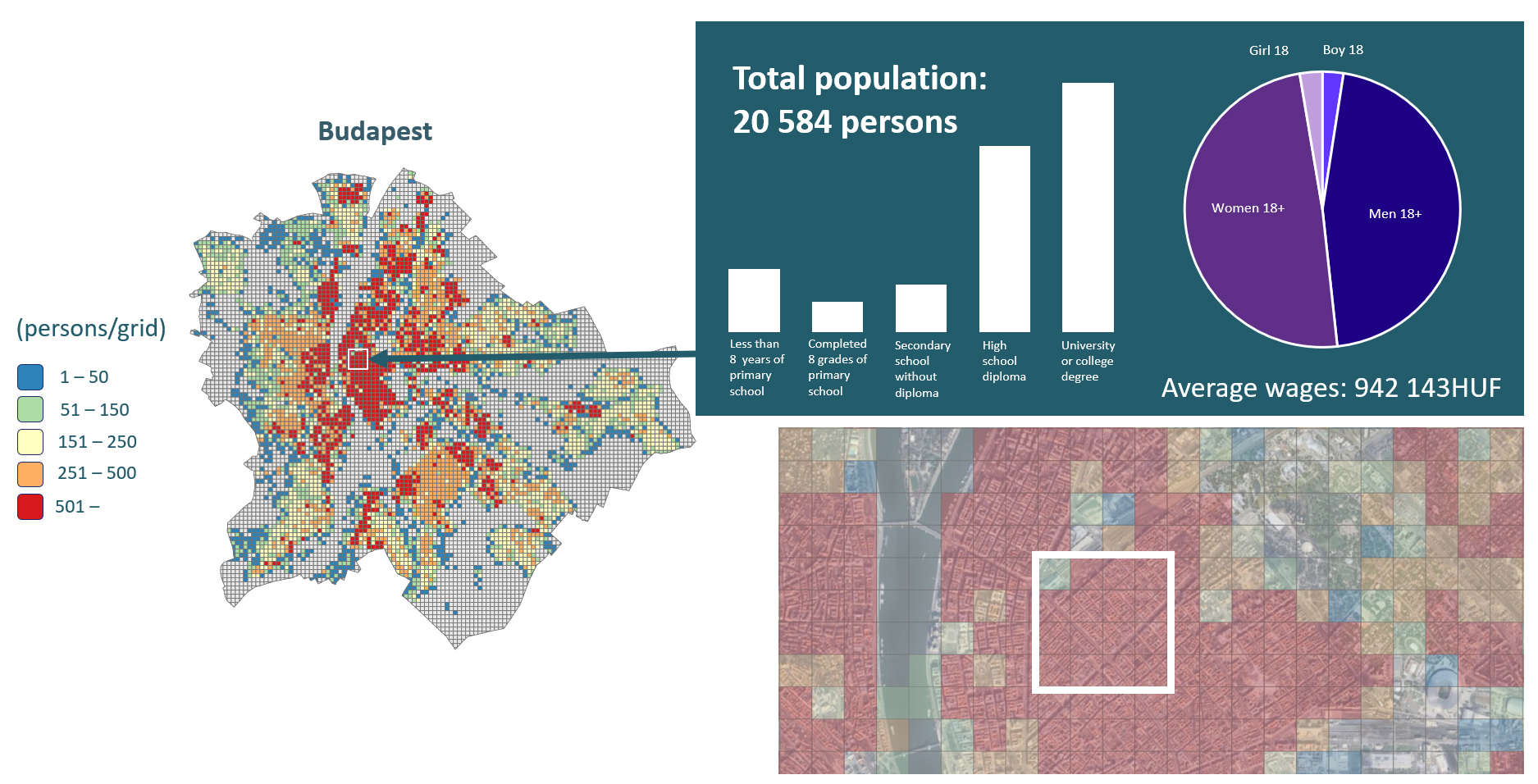
Possibilities of spatially detailed statistical analysis in grid level integrated datasets
Conference
Regional Statistics Conference 2026
Format: CPS Paper - RSC 2026
Keywords: "geographic information system, #officialstatistics, grid, hungary
Session: CPS 31 Data Integration
Thursday 4 June 10:30 a.m. - 11:30 a.m. (Europe/Malta)
Abstract
In the emerging data era, demand for increasingly detailed information is steadily growing, hence providing the chance to mirror processes of the economy and society more adequately. Although such highly disaggregated datasets can usually be generated independently, their true added value lies in their integration with other sources. In response to exploit the advantages, the Hungarian Central Statistical Office has prioritized the multi-purpose use of data (the enhancing of interoperability), the benefits arising from structuring and linking datasets (creating a form of “data space”), as well as the interpretation and visualization of detailed data to ensure accessibility and usability. A new data ecosystem grounded in spatial granularity and interoperability is being developed to enhance both the relevance and the utility of official statistics. To address these challenges, the Hungarian Central Statistical Office has initiated the Virtual Hungary pilot project, which seeks to organize the most detailed datasets into a fully integrated system. This paper aims to introduce the possibilities of small level detailed data integration within the framework of this project by choosing grid level aggregated analytical cases. Examples are presented on how the spatial analytical challenges have been embraced by incorporating new data sources. Grid level integrated datasets proved usefulness not only because they offered an opportunity to bridge the gap between detailed spatial information analysis and sensitive data disclosure, but also because of opening completely new avenues of spatial analytical possibilities.
Figures/Tables
fig2