
Leveraging Earth Observation for the Modernization of Agricultural Statistics
Conference
Format: CPS Poster - IAOS 2026
Keywords: crop area estimation, machine-learning, remote sensing
Session: Poster Session
Tuesday 12 May 12:30 p.m. - 2:30 p.m. (Europe/Vilnius)
Abstract
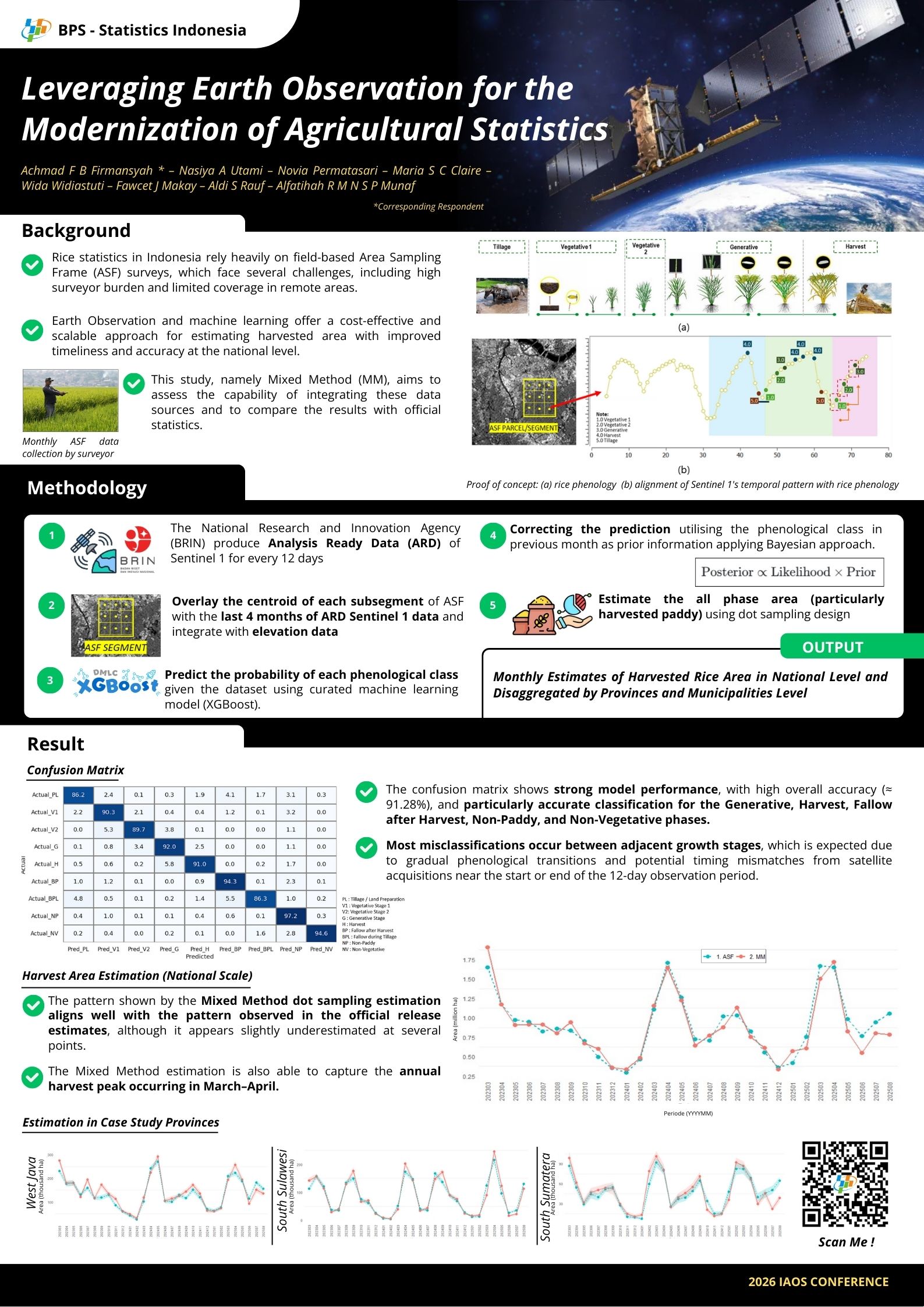
Modernizing agricultural statistics is essential to support timely, accurate, and cost-efficient food policy decisions, especially in rice-dependent countries such as Indonesia. In line with the National Long-Term Development Plan (RPJPN) 2025–2045, this study examines how Earth Observation (EO) data and machine learning can be used to strengthen official agricultural statistics. The main objective is to compare rice harvest area estimates derived from remote sensing–based methods with those produced by the conventional Area Sampling Frame (ASF) survey, which is currently used as the official reference.
This study develops a mixed method that integrates satellite data and field survey information. Sentinel-1 radar imagery is combined with ASF observations to train a machine learning model (XGBoost) to classify rice growth stages. To ensure realistic and consistent temporal patterns, a Bayesian post-processing step is applied to correct implausible transitions between phenological stages. The predicted growth stages are then aggregated using the standard ASF sampling design to produce harvest area estimates, along with measures of uncertainty such as standard error (SE) and relative standard error (RSE), following official statistical procedures.
The results show a strong agreement between EO-based estimates and ASF survey results from March 2023 to August 2025. Both methods capture similar seasonal patterns, with peak harvests consistently occurring in March–April and lower harvest levels toward the end of the year. At the provincial level, model performance is generally high, particularly in major rice-producing regions where training data are more abundant. The post-processing step significantly improves classification accuracy and temporal consistency, demonstrating the importance of incorporating prior knowledge on crop growth dynamics.
Although EO-based estimates tend to have slightly higher variability than ASF estimates and show some over- or under-estimation during certain periods—especially in regions with complex cropping systems—the overall trends are highly consistent. The model successfully captures different regional harvest patterns, including provinces with multiple harvest peaks, indicating its ability to reflect diverse agricultural conditions across Indonesia.
Overall, this study demonstrates that EO and machine learning can effectively complement conventional field surveys for agricultural statistics. While not intended to immediately replace ASF surveys, the proposed approach offers a scalable and efficient alternative that can reduce field costs, improve spatial coverage, and enhance timeliness. These findings provide a strong empirical basis for the gradual integration of EO-based methods into official agricultural statistics, supporting more robust and evidence-based food policy decision-making.