
Completeness-Corrected Mortality Forecasting for Indonesia Using Remote Sensing and Spatial Count Models
Conference
Format: CPS Poster - IAOS 2026
Keywords: big data, mortality, remote sensing, survival analysis
Session: Poster Session
Tuesday 12 May 12:30 p.m. - 2:30 p.m. (Europe/Vilnius)
Abstract
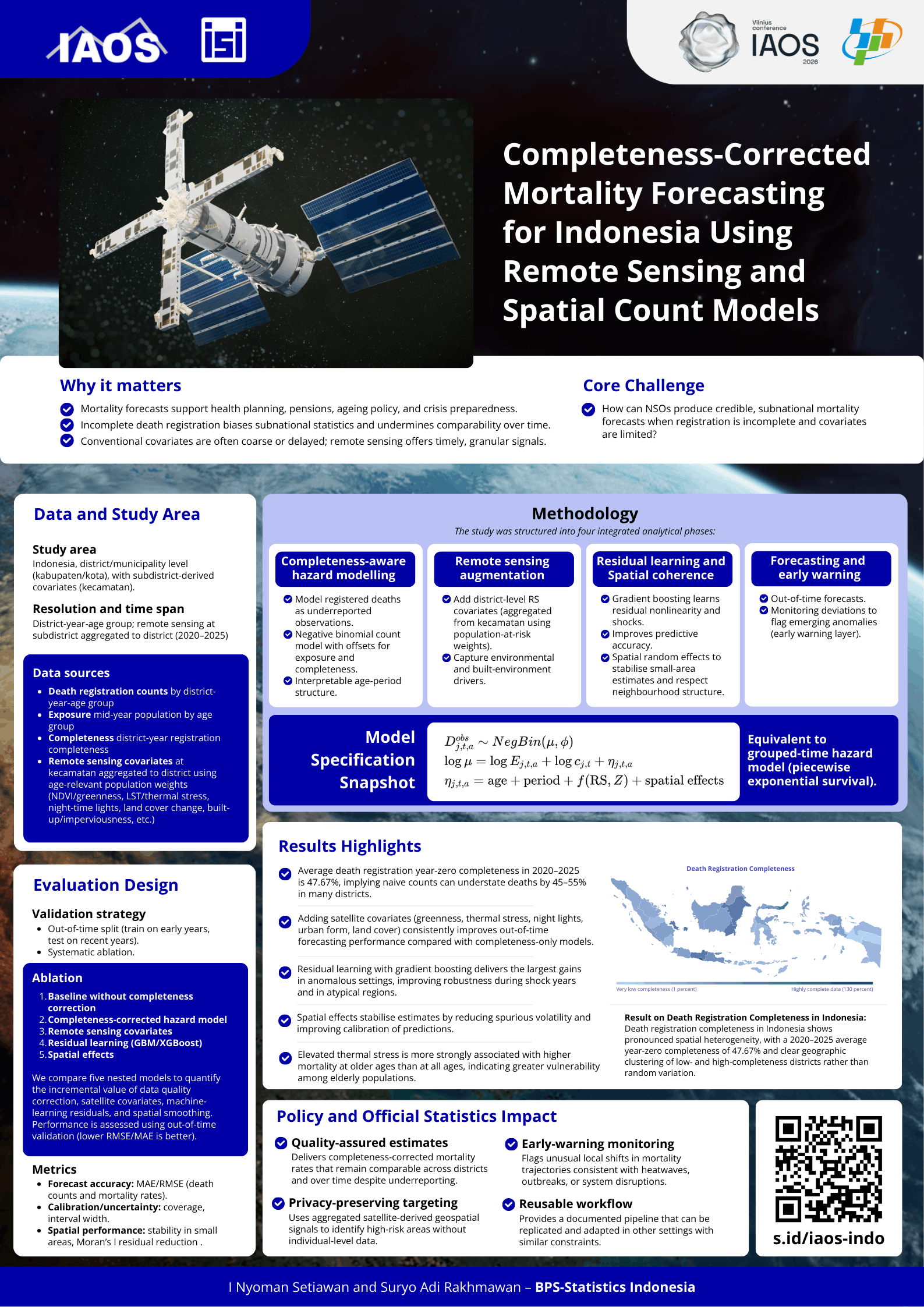
Mortality forecasting is central to evidence-based planning for public health, social protection, and population ageing. However, in many national statistical systems including Indonesia, its operational value is often constrained by two structural limitations: (i) death registration that remains incomplete and temporally varying across areas, and (ii) the scarcity of timely, spatially granular covariates that can support subnational modelling and early warning. In the context of the data revolution, this study develops a scalable, quality-aware framework that integrates satellite-derived remote sensing signals with demographic count modelling to produce completeness-corrected mortality estimates, enhance forecasting performance, and generate actionable geospatial risk surfaces for policy targeting.
We compile a multi-source, multi-resolution dataset for Indonesia comprising annually aggregated registered deaths at the district/municipality (kabupaten/kota) level disaggregated by age group, corresponding exposure (mid-year population) by age group, and district-year completeness rates of death registration. To enrich the covariate space, we extract remote sensing features at the subdistrict (kecamatan) level and aggregate them to districts using age-relevant population weights, thereby aligning environmental and built-environment signals with the spatial distribution of populations at risk. The remote sensing indicators capture conditions plausibly associated with mortality differentials, including vegetation and thermal stress proxies, urban form and imperviousness, night-time lights, and land-cover dynamics.
Methodologically, we treat registered deaths as underreported observations rather than ground truth. Observed death counts are modelled using a negative binomial specification with offsets for exposure and registration completeness, yielding principled estimates of underlying age-specific mortality rates under imperfect reporting. The proposed negative binomial hazard model is equivalent to a piecewise exponential survival model, extended with completeness correction and geospatial covariates. To accommodate nonlinearities, shocks, and complex spatial heterogeneity, we extend the demographic backbone (age and period components) with a hybrid residual-learning architecture in which gradient boosting models learn systematic residual variation from remote sensing and contextual covariates. Spatial dependence is formally assessed and incorporated through spatial random effects, strengthening statistical coherence across neighbouring districts and improving stability in small-area estimation. This design preserves interpretability for official statistical use while enabling measurable gains in predictive accuracy.
The framework is evaluated through out-of-time validation and systematic ablation, comparing models with and without completeness correction, with and without remote sensing augmentation, and under alternative spatial structures. Primary outputs include completeness-corrected all-age mortality and elderly mortality, enabling assessment of differential vulnerability to environmental and urban exposures. Finally, to support proactive decision-making, corrected forecasts are operationalised into an early-warning monitoring layer by tracking deviations between expected and observed completeness-adjusted trajectories to flag emerging local anomalies.
By jointly addressing data quality constraints and spatial information gaps, this study contributes a reproducible approach for leveraging new data sources and AI-enabled modelling to improve mortality estimation and forecasting within official statistics by delivering (1) statistically principled estimates of true mortality under imperfect data, (2) improved district-level forecasting, and (3) subdistrict-informed risk surfaces for targeted interventions, providing an actionable, data-driven tool for proactive demographic and public health planning in Indonesia.