
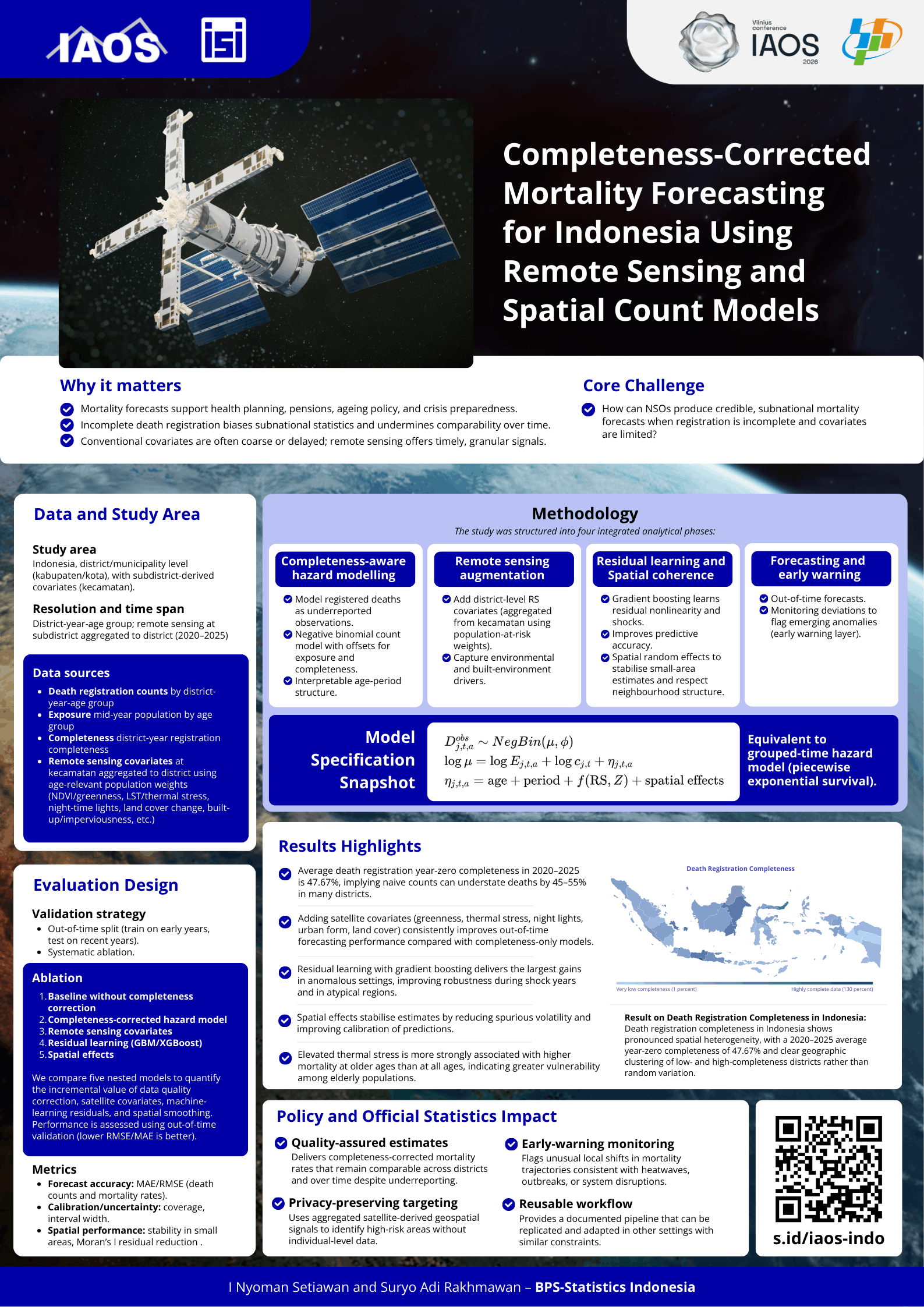
Completeness-Corrected Mortality Forecasting for Indonesia Using Remote Sensing and Spatial Count Models
Conference
Format: CPS Poster - IAOS 2026
Keywords: big data, mortality, remote sensing, survival analysis
Session: Poster Session
Tuesday 12 May 12:30 p.m. - 2:30 p.m. (Europe/Vilnius)
Abstract
Mortality forecasting is central to evidence-based planning for public health, social protection, and population ageing. However, in many national statistical systems including Indonesia, its operational value is often constrained by two structural limitations: (i) death registration that remains incomplete and temporally varying across areas, and (ii) the scarcity of timely, spatially granular covariates that can support subnational modelling and early warning. In the context of the data revolution, this study develops a scalable, quality- aware framework that integrates satellite-derived remote sensing signals with demographic count modelling to produce completeness-corrected mortality estimates, enhance forecasting performance, and generate actionable geospatial risk surfaces for policy targeting.
We compile a multi-source dataset for Indonesia comprising annually aggregated registered deaths at the district/municipality (kabupaten/kota) level disaggregated by age group, corresponding exposure (mid-year population) by age group, and district-year completeness rates of death registration. Remote sensing covariates are derived directly from raster-based geospatial data and aggregated to district level, capturing environmental and built-environment conditions. Indicators include vegetation proxies, thermal stress measures, night-time lights, air pollution, and urbanisation characteristics.
Methodologically, we treat registered deaths as underreported observations rather than ground truth. Observed death counts are modelled using a negative binomial specification with offsets for exposure and registration completeness, yielding principled estimates of underlying age-specific mortality rates under imperfect reporting. The model is extended with remote sensing covariates, residual learning to capture nonlinear variation, and spatial effects to improve stability.
Empirically, results show that a parsimonious set of remote sensing indicators explains a substantial share of spatial variation in mortality outcomes, with air pollution and urbanisation emerging as dominant predictors. Model simplification improves stability and interpretability while maintaining predictive performance. The framework produces completeness-adjusted mortality estimates that enhance comparability across districts and provide a scalable foundation for routine statistical production and policy-relevant monitoring.