How a Stat Lab in a Private Institution Functions to Promote Statistical Collaboration
Abstract
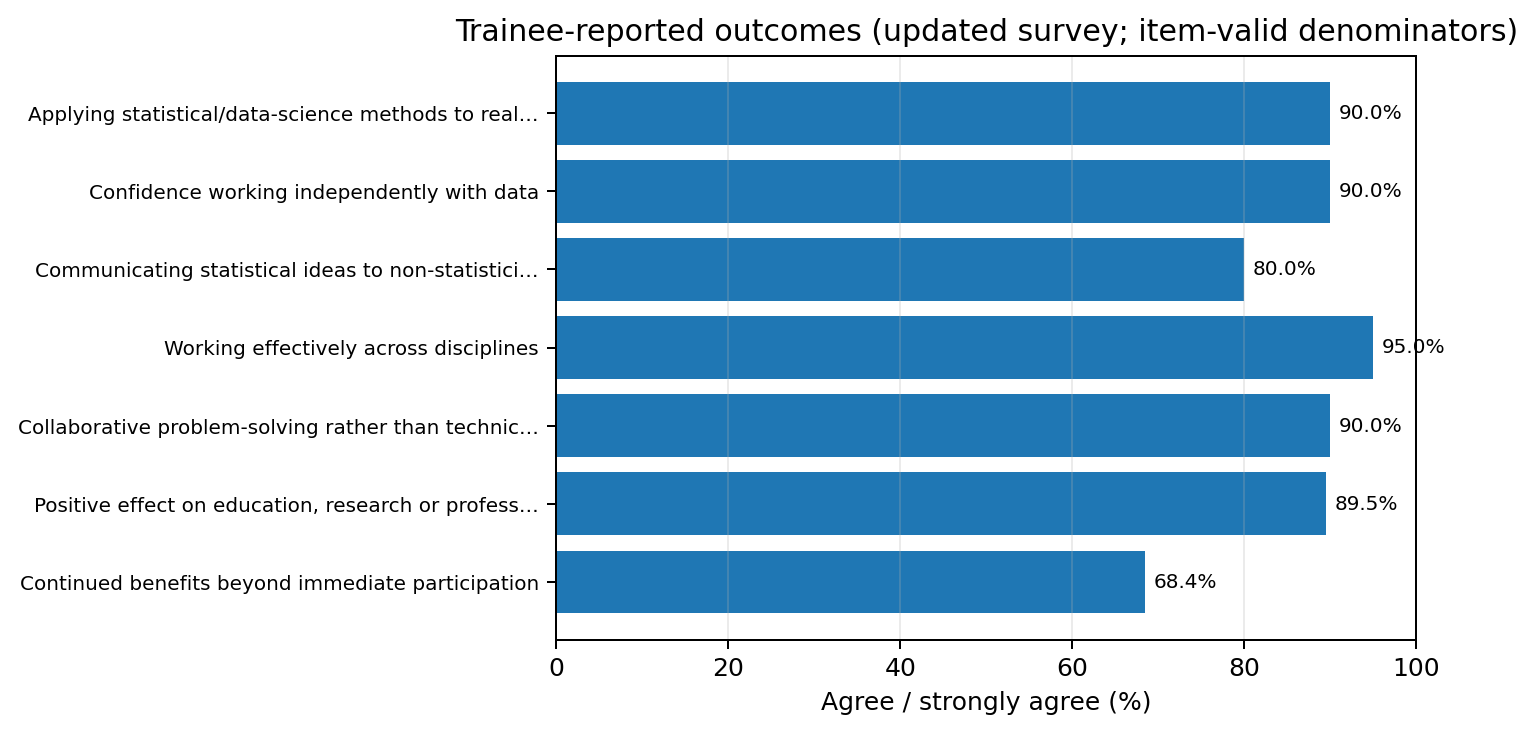
Statistical education is most valuable to business and industry when graduates can do more than select a model or run software. They should be able to; clarify a client’s questions, understand the operational context, choose suitable methods, work productively with people from other disciplines and translate findings into useful actions. This paper examines how a statistical collaboration laboratory (stat lab), including one hosted by a private institution, can help prepare collaborative statisticians for business, government, industry and research. The network record reports 3,313 collaborative projects, 8,028 training records, 837 educational events and 619 publications; however, reporting coverage fell to 19 of 36 laboratories in 2025, so activity totals should not be interpreted as complete measures of impact. As such, it more so provides an evidence based angle by analyzing a recent LISA 2020 impact survey involving 47 respondents and good number of variables across affected target groups, together with the network’s past seven year monitoring records documented LISA 2020 network database. The survey’s group target specific branches covers; trainees, statistical practitioners, domain experts, institutional administrators and lab leaders. Among 20 trainees; 18(90%) reported positive change in applying statistical/data science skills to research and collaborative problem-solving, 19(95%) got better at working across disciplines, and 16(80%) improved in communicating with non- statisticians. Response from the short stories revealed a trainee who later helped a public-health postgraduate student by clarifying research questions and selecting the appropriate research design rather than just performing the analysis. Other responses revealed independent use of R, training public sector statistical staff, collaboration with a state bureau of statistics, and statistical input local government developmental work. Lab leaders on the one hand identified funding, staffing, computing resources, institutional support as constraint for sustainability. This paper thus argues that stat labs are most educationally effective when students participate throughout a project lifecycle, receive mentoring, and are assessed on technical quality communication, ethics and evidence use. These are exploratory, self-reported findings, not causal estimates. The paper argues that a private-institution stat lab can prepare collaborative statisticians through supervised client-facing projects, multidisciplinary teams, iterative communication, short-course delivery and partnerships with industry and public agencies.
Figures/Tables
Figure 1. LISA 2020 Network Impact Survey (positive = Agree or Strongly agree)