Keywords: data ecosystem, data governance, data-science education
Abstract
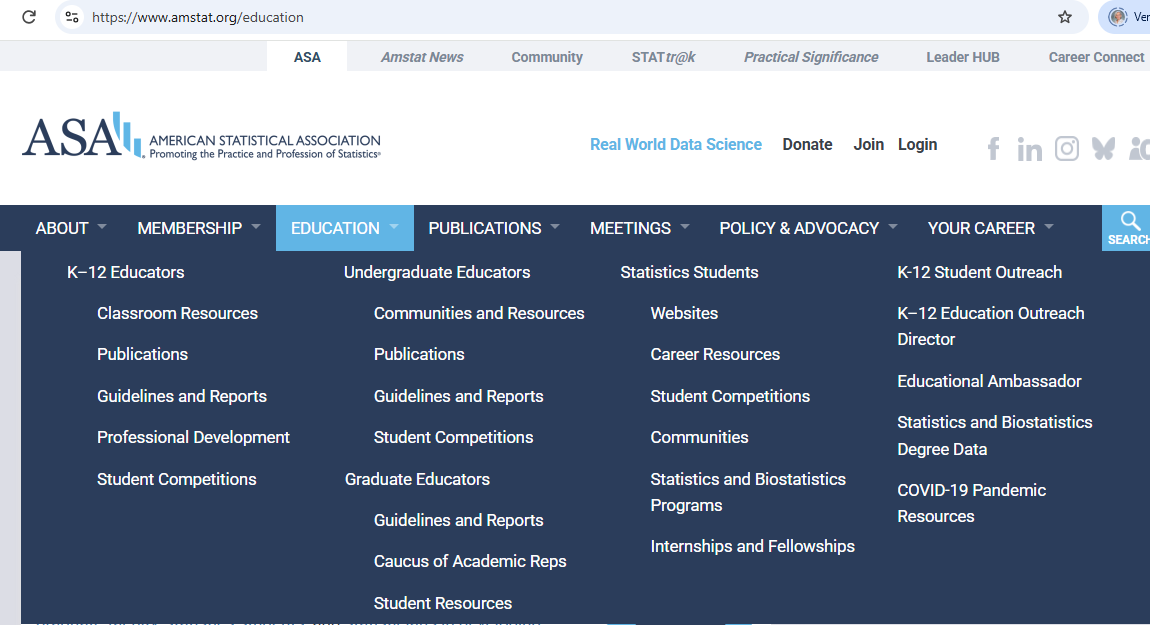
The American Statistical Association (ASA) identified education as a strategic goal of the association long time ago. As their website says, "they work to provide leadership to improve statistics education at all levels, build a statistically literate society, make the study of statistics and statistical careers more atractive, and enhance the preparation of statisticians for success." To that end, and in collaboration with statisticians, the society takes a leadership role in developing teaching guidelines for pre-college, college (the GAISE reports) and postgraduate education, resources for education at those levels, and activities that support the practice of the guidelines. They have been doing that for decades, and they have had an impact on the improvement of the teaching of statistics. They do that with paid staff dedicated exclusively to the strategic goal (what we shall call "the education office" of the ASA). Separately, the ASA has sections encompassing different statistical interests, one of which is the Section on Statistics and Data Science Education (SSDSE). This section, run by volunteers, is obviously interested in statistics education, but it is basically in charge of organizing the conference program on that topic for the annual conference, and conference related matters in addition to some minor initiatives. Some members of such section volunteer to help with the strategic plan (committees organized by the education office, education journals, etc). The Section does not set the guidelines for teaching statistics or content. Sections are, in the ASA, what Associations (IAOS, IASE, etc) are in the ISI. Using the ASA model, this talk presents an investigation of how a statistical society's leadership role in setting guidelines for teaching statistics might influence how teachers approach the teaching of statistics in the age of AI, illustrating this by examples of position documents, published reports, and journal publications. The talk also presents evidence from a survey of countries' statistical societies that illustrates the prevalence or absence of the practice of having dedicated staff to support a strategic education goal that extends from pre-school to post college practice and teaching guidelines. A discussion of what guidance teachers of statistics might have to support best teaching practices in the age of AI, and the prospects of AI widening the gaps in statistics education concludes the talk.