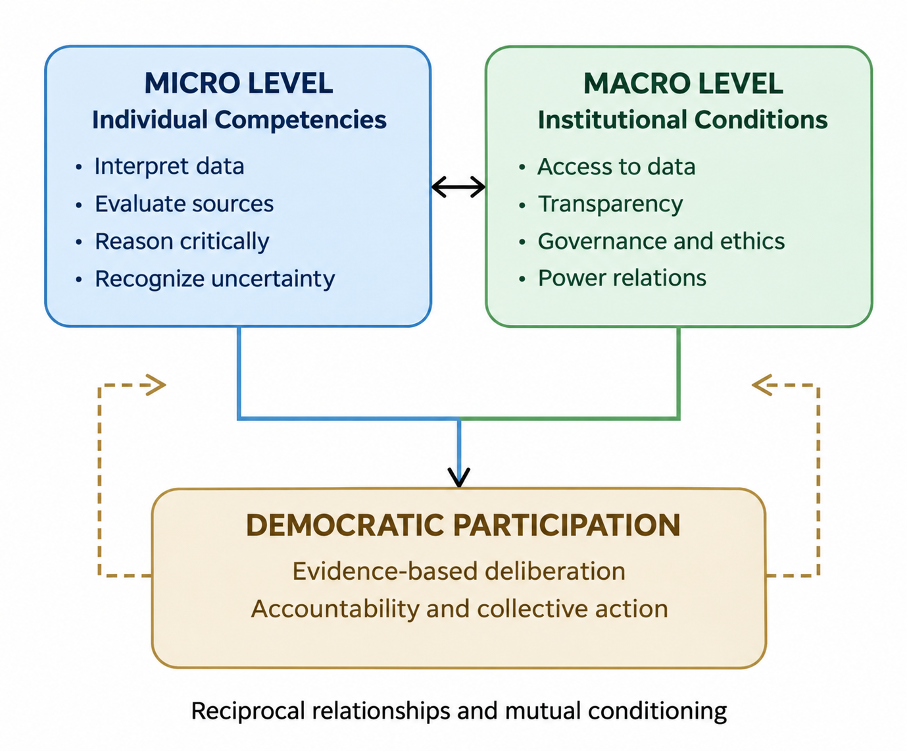
In an era of political polarization, misinformation, and increasingly data-driven public discourse, statistical literacy has become an essential resource for democratic participation. Yet statistical literacy is more than an individual cognitive achievement: it is a civic capability that enables citizens to critically evaluate evidence, challenge misleading claims, and participate in informed democratic deliberation. This paper develops an integrative conceptual framework that connects statistical literacy, Civic Statistics, Critical Data Literacy, and democratic education. Drawing on a selective review of these complementary perspectives, the framework distinguishes two interrelated dimensions: individual competencies for interpreting statistical information, evaluating evidence, reasoning critically, and recognizing uncertainty; and social and institutional conditions that enable or constrain the exercise of these competencies, including access to reliable data, transparency, data governance, and power relations. The central argument is that civic statistical literacy cannot be understood independently of the contexts in which statistical information is produced, communicated, and used. Individual competencies and institutional conditions interact reciprocally: while democratic institutions can facilitate or restrict citizens' engagement with evidence, statistically literate citizens can challenge dominant narratives, demand accountability, and contribute to transforming institutional practices. Statistical literacy thus becomes both a resource for democratic participation and a means of critically examining the conditions under which such participation takes place. The framework is illustrated through the challenge of rising right-wing populism, examining how statistical evidence concerning migration, inequality, and social change enters political narratives and public debates. These examples highlight the interplay between citizens' capacities to evaluate statistical claims and the institutional and communicative environments that shape their interpretation. By recognizing the diversity of political and institutional contexts across continents, the paper argues for an approach to statistics education that moves beyond individual skills toward civic empowerment, critical engagement, and collective democratic agency.